Public transit networks are often designed for areas with high population density and predictable demand. Those assumptions do not always work in small cities, rural communities, and dispersed suburban areas.
Longer distances, lower passenger volumes, and limited operating budgets can make frequent fixed-route services difficult to sustain. As a result, residents may have access to a transit network but still struggle to reach jobs, education, healthcare, and essential services.
A 2024 study of 1,056 residents in El Paso, Texas, found that distance to bus stops can be a significant barrier to public transit use. Respondents indicated that first-mile shuttle connections could increase their use of transit, showing how access to stops can influence ridership.
European policy frameworks increasingly treat accessibility as a core objective of sustainable mobility, rather than a secondary benefit. The European Environment Agency highlights that improving first- and last-mile connections is critical to reducing car dependency and increasing public transport use.
Small-city and rural transit networks face different operating conditions from large urban systems. The key limitations include:
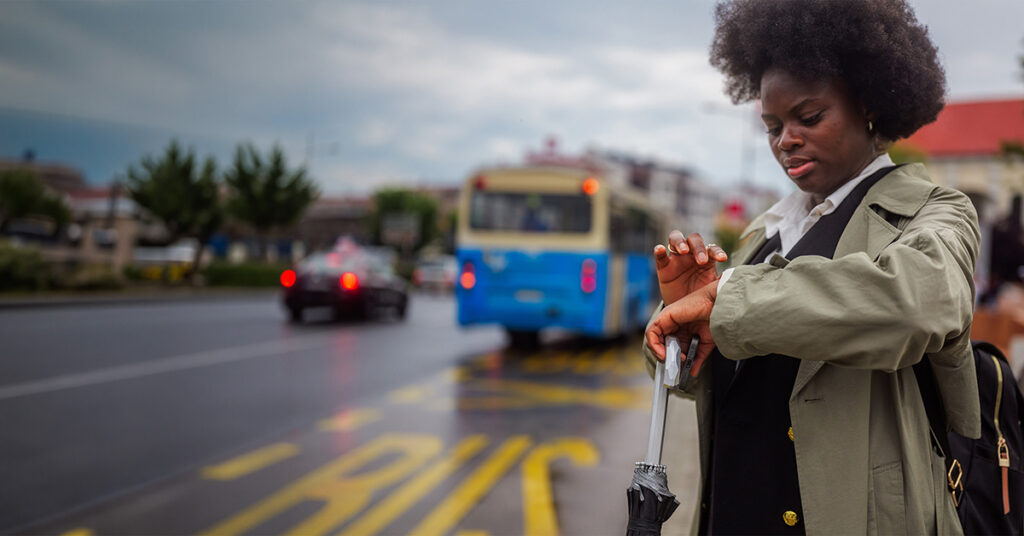
A service may connect several towns but operate only a few times per day. That schedule may not support commuters, students, or passengers travelling to medical appointments. Missing one departure can also mean waiting several hours for the next service.
This mismatch between service availability and practical usability can make public transit less practical for many trips, particularly in rural and small-city communities. Rural transit research shows that routes may exist but still fail to support work, healthcare, or shopping trips when schedules and service design do not match local travel needs.
In dense urban areas, the first- and last-mile journey may involve only a short walk. In rural communities, passengers may need to travel several kilometres to reach a bus stop or rail station, often where pavements, cycling infrastructure, and feeder services are limited or unavailable.
A 2023 Washington State study shows that public transit accessibility depends on both proximity to stops and service frequency. If the first connection is difficult to reach or operates infrequently, the usefulness of the wider transit network may be reduced.
In low-density areas, this is particularly pronounced where missing a single connection may result in hours of delay or no viable return journey. For example, a passenger travelling to a medical appointment may rely on a local shuttle to connect with a regional bus. If the shuttle is delayed, they may miss the connection and be unable to complete the journey or return home until much later.
Several persistent structural challenges continue to define rural and small-city transit systems:
Together, these challenges create uneven access to public transport. Even where transit exists, it’s not equally usable across geographic areas or demographic groups. This lack of access can compound social and economic divisions, making it harder for people to access employment, education, and training opportunities.
Research on transport equity shows that lower-income communities may have significantly less access to jobs by public transport than by private car. For many households, the need to own and maintain a private vehicle can also place additional pressure on family budgets.
Demand-responsive transit (DRT) can complement fixed-route services in areas where passenger demand is low or widely dispersed. Rather than relying solely on fixed schedules, agencies can use booking, dispatch, driver management, and scheduling tools to match vehicles with actual travel demand.
Common implementations include:
In rural and small-city transit systems, uncertainty can discourage people from using public transport. Passengers need confidence that services will arrive on time and that connections can be made reliably.
To reduce this uncertainty, modern systems increasingly rely on real-time data:
Reliable information helps passengers make informed travel decisions by providing accurate arrival times, delay updates, and connection information. This is particularly important in low-frequency networks, where missing a single connection can disrupt an entire journey.
Integrated mobility systems connect different transport modes, operators, and passenger services into a more coordinated network.
This can include:
By bringing these services together, integrated mobility systems make fragmented transport networks easier to use. They simplify journey planning, ticketing, payments, and transfers while helping passengers move more easily between operators and modes of transport.
European transport policy increasingly emphasizes interoperability across ticketing, digital payments, passenger information, and multimodal services as key foundations for more connected and inclusive mobility.
Transit agencies serving rural and small-city communities need connected tools to plan services, coordinate operations, and provide accurate passenger information. Enghouse Transportation’s Transit Management solutions help agencies manage fixed-route and demand-responsive services within a single operational environment.
The platform connects:
By connecting planning, operations, fare collection, and passenger information, agencies can coordinate fixed-route and demand-responsive services more effectively. For rural and small-city transit systems, this integrated approach can improve service reliability, simplify operations, and provide better passenger experience.
Small-city and rural transit agencies face unique operational challenges, but better coordination between planning, operations, passenger information, and fare collection can help improve service accessibility and reliability.
Learn how Enghouse Transportation’s Transit Management solutions support connected, flexible transit networks for rural and small-city communities.
Explore Transit Management Solutions
What is demand-responsive transit (DRT)?
Demand-responsive transit (DRT) is a flexible public transport service that adjusts routes or schedules based on passenger demand. It can complement fixed-route services in rural and small-city communities where demand is lower or more dispersed.
Why is first- and last-mile access important?
First- and last-mile access determines how easily passengers can reach a bus stop or rail station and complete their journey. Improving these connections can make public transport more practical and accessible, particularly in low-density areas.
How can integrated mobility improve rural public transport?
Integrated mobility connects journey planning, passenger information, fare payment, and transport operations into a single system. This helps passengers plan and complete journeys more easily while supporting better coordination between transport operators.
How does real-time passenger information improve the travel experience?
Real-time passenger information provides up-to-date arrival times, service alerts, and connection information. This helps passengers make informed travel decisions and is especially valuable on low-frequency routes where missing a connection can significantly affect a journey.