


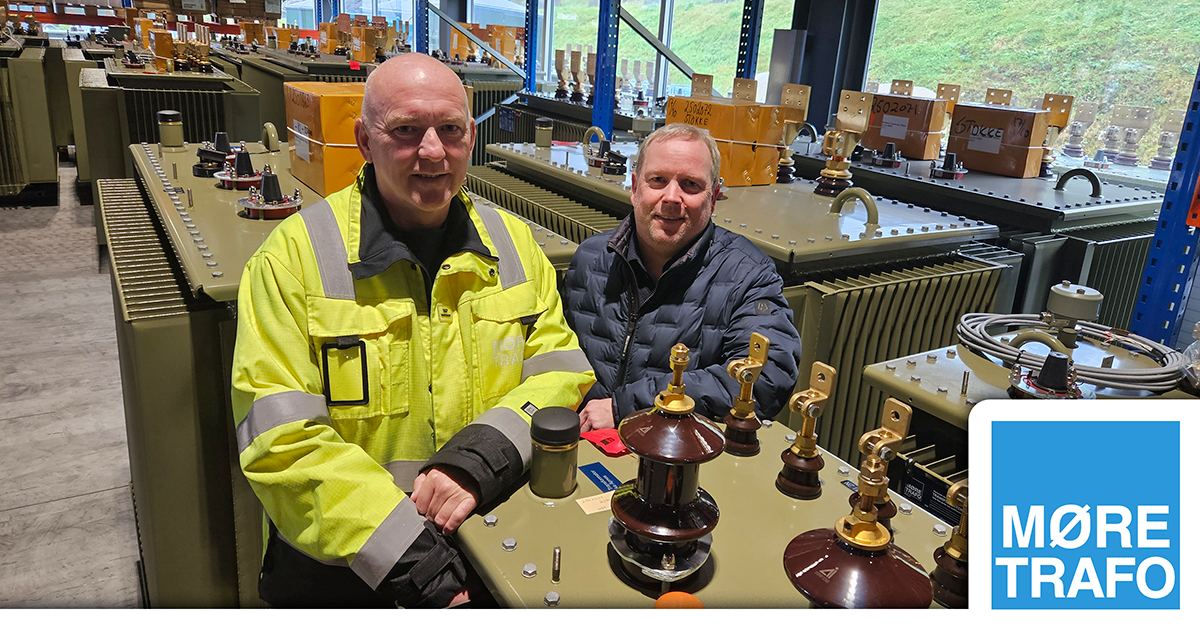
Møre Trafo is Norway’s leading manufacturer of distribution transformers and compact substations, based in Sykkylven on the west coast. Since 1951, they have supplied grid companies and contractors across Scandinavia who depend on reliable deliveries and high product quality. With around 3,000 transport assignments a year and three main carriers, logistics transportation management is a critical part of how they keep the power on for their customers.
For many years, transport handling at Møre Trafo was largely manual. Freight documents were printed or sent as PDFs in multiple copies, and it could take days before anyone could say exactly where a shipment was. Customer service spent a lot of time calling carriers for status updates, while the logistics team had limited real-time visibility, just as shipment volumes and product complexity were increasing.
When Møre Trafo introduced the M3 ERP system in 2010, they saw an opportunity to modernise logistics at the same time: to connect order management, transport planning, carriers and tracking into one digital flow. Enghouse’s Log:Nett transport administration system, a transportation management system (TMS) for outbound logistics, was chosen to sit between M3 and the transport providers, automating freight documents, EDI messages and tracking data. Today, with M3 running in the cloud and tightly integrated with Log:Nett, Møre Trafo has a stable logistics backbone that gives both employees and customers instant answers about every delivery, including those eight trucks that have to be loaded and rolling first thing Friday morning.
When Møre Trafo moved from their long-standing AS400 platform to M3 in 2010, it was a natural evolution. The company was growing, product variants were multiplying and manual routines were becoming a bottleneck.
“M3 builds on a familiar structure but offers far greater flexibility. For us, continuity and the ability to customise were crucial,” say Warehouse Manager Frank Hansen and Purchasing and Logistics Manager Ole Jakob Tronstad.
In 2024, M3 was moved to the cloud. That gave stronger data security and more robust operations. Before the cutover, Møre Trafo ran an extensive test period to make sure all the customisations and the integration with their transportation management system worked exactly as expected. The result is a stable, future-proof foundation for both production and logistics.
Standard M3 functionality covers around 85 percent of Møre Trafo’s needs. The remaining 15 percent is handled by customisations that reflect how their business really works, from technical test protocols to product configuration in the customer portal.
“Our products are rarely identical. We need one system that supports standard processes that also lets us build in our own logic without losing overview,” say Hansen and Tronstad.
The customer portal is embedded in M3 and allows customers to configure products, check prices and send orders directly for technical review and production. This tight link between product data and order handling makes it possible to connect seamlessly into downstream TMS logistics and EDI processes.
Digitalisation at Møre Trafo does not stop at the factory gate. Together with Enghouse, they integrated M3 with the Log:Nett transport administration system, creating a fully digital flow from order to delivery.
When a shipment is created in M3, all necessary information, consignment details, dimensions, weights, addresses and contact data is automatically sent to Log:Nett. There, the logistics team manages transport bookings and documentation in a dedicated TMS logistics environment instead of juggling spreadsheets and emails.
“From the start, our goal with Møre Trafo wasn’t to add another system on top of their work, but to remove manual steps in the background. When M3 and Log:Nett talk seamlessly together, the logistics team can focus on decisions and customers instead of chasing freight documents and status updates.” says Erik Egelund, Customer Success Manager at Enghouse Transportation, Locus division.
Solutions like this don’t just remove paper and manual work, for companies operating in and with the EU Single Market, they also align with European initiatives to digitalise freight information, such as the EU’s Electronic Freight Transport Information (eFTI) framework, which is currently being assessed for incorporation into the EEA Agreement.
Log:Nett acts as a hub between the ERP and the carriers, automating work that used to be manual and error-prone and forming the core of Møre Trafo’s logistics transportation management.
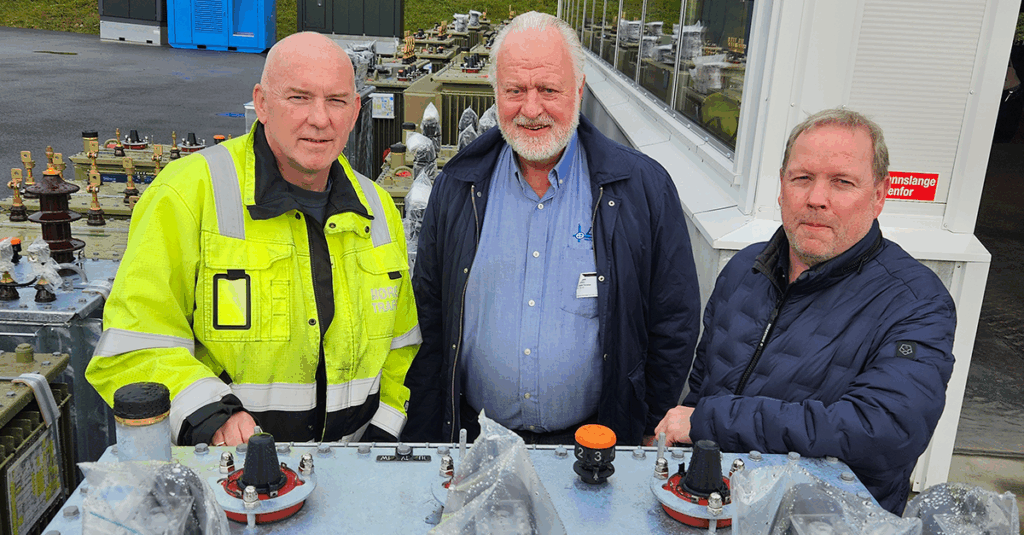
Three main carriers, Bring, Veøy Møre and Einar Valde, are connected to Møre Trafo via Log:Nett using electronic data interchange (EDI). If you’re new to EDI, GS1 UK has a clear introduction to what electronic data interchange (EDI) is and how it supports accurate, standardised data sharing in the supply chain.
What starts as a sales order in M3 becomes a transport order in Log:Nett and then an EDI message to the carrier, without anyone retyping a single line.
Log:Nett functions as specialised electronic data interchange software that validates addresses, labels and consignment data before anything is sent out. This EDI integration ensures that each carrier receives the information in the exact format their systems expect, reducing errors and delays.
“We hardly notice that Log:Nett is there, and that’s a good sign. The system does its job in the background, and any deviations are picked up quickly by Enghouse’s IT team,” say Hansen and Tronstad.
One of the biggest gains from the integration is faster, more accurate information flow.
Customer service no longer has to call carriers for updates. With real time shipment tracking available through Log:Nett, they can answer delivery questions in seconds. Selected customers also have access to tracking themselves, which reduces the number of “where is my shipment?” calls.
“When customers can follow their shipments online, it saves time for everyone and gives better control both internally and externally,” explain Hansen and Tronstad.
The same tracking data supports better planning in the warehouse and smoother coordination with production, everyone sees the same status.
For a broader industry perspective, McKinsey’s 2024 Global Supply Chain Leader Survey shows that many companies have accelerated projects to improve supply chain visibility and are now starting to reap the benefits of better real-time data and tracking across their networks.
For Møre Trafo, user-friendliness matters more than fancy interfaces.
“‘Keep it simple’ is our principle. The system must be intuitive and efficient to use. What happens in the background is less important, as long as it works,” say Hansen and Tronstad.
That’s exactly how they experience their combination of M3 and Log:Nett: a reliable transportation management system that runs in the background, handles large data volumes and keeps logistics moving without adding complexity for users.
They still see room for improvement, especially even better traceability when third-party carriers are involved, and more automation on inbound logistics – but the foundation is in place.
By connecting M3 and Log:Nett, Møre Trafo has built a unified digital chain that links order handling, production and outbound logistics. The result is fewer manual tasks, faster answers and better control over every shipment.
“Møre Trafo has a clear ‘keep it simple’ philosophy, and we share that. Our job is to make sure the transport management flow is stable, predictable and easy to use, while we handle the complexity of carriers, formats and integrations behind the scenes.” shared Erik Egelund
“The solution gives our customers better service through full overview and traceability,” conclude Hansen and Tronstad.
Møre Trafo AS Fact Box
| Established | 1951 by Oddvar Rieve Kristiansen, under the name AS Møre Transformatorfabrikk |
| Location | Sykkylven, Møre og Romsdal |
| Ownership | Part of the Møre Electric Group – 66 percent owned by the Rieve Group and 34 percent by Schneider Electric |
| Sister company | KL-Industri AS in Finspång, Sweden (113 employees) |
| Core business | Production of distribution transformers and substations for the Scandinavian market |
| Market position | Market leader in Norway in distribution transformers |
| Customers | Grid companies and contractors requiring reliable deliveries and high quality |
| Transport partners | Bring, Veøy Møre and Einar Valde |
| Logistics volume | Approx. 3,000 assignments through Log:Nett per year |
| ERP system | M3 |
| Transport Administration System (TA) | Log:Nett from Enghouse – Locus division |
| Purpose | Efficient and traceable handling of all transport assignments, with EDI integration between M3 and Log:Nett |