Every day, millions of Americans find themselves ensnared in traffic, inching through other vehicles’ exhausts while growing frustrated and achieving exactly nothing. That’s the daily commute; on average, it takes 26.4 minutes each way — significantly longer for many.
Despite that waste of time, resources, and serenity, 73% of Americans drive alone to work. And with the sprawl of U.S. cities making access difficult, getting them to try transit instead has traditionally been a hard sell.
However, there are technological solutions transit agencies can leverage to entice commuters to make the switch to a more environmentally friendly, safer, and less stressful option. Here are five ways to get commuters to think beyond the car.
1. Integrate micromobility and parking to improve transit access.
Micromobility has taken off in the United States, with many bike-sharing, scooter, and ride-sharing companies now having sophisticated solutions with widespread acceptance.
Micromobility companies are not transit’s competitors — they are its complements. According to the American Public Transportation Association, shared mobility enhances urban transportation, closing the first- and last-mile gap, getting more people into the habit of leaving their cars at home, and ultimately increasing ridership on traditional transit. Even parking can play a role, enabling commuters to drive a short distance to a transit station, rather than all the way to work, before leaving their cars behind.
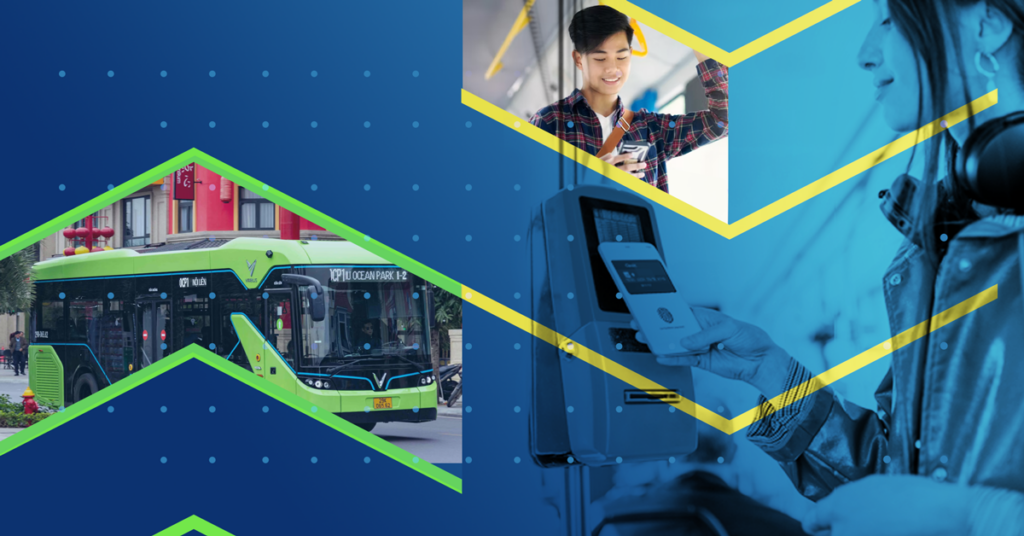
Integrating parking and micromobility with transit starts with automated fare collection (AFC). That means using open-loop payment methods, like mobile apps and credit cards, that let customers access transit instantly with a tap to a validator. In this type of system, every transit customer also has an individual account maintained in a back-office server, including information like the account balance, billing schedule, applicable fare rules, and travel records and receipts.
With AFC systems, transit agencies can connect with mobility and parking partners in a mobile app to enable integrated travel planning, pricing schemes, rewards, and other programs that can make a multistep commute feel more like one connected trip.
2. Enable discounted pricing plans and rewards.
Once an AFC system and customer accounts are in place, transit agencies can enable even more passenger rewards and discounts. Because customers will have payment methods tied to their bank accounts or credit cards, agencies can use fare capping, billing weekly or monthly, and ensure that riders always get the best price.
Other types of rewards are possible through micromobility partnerships. For example, customers disembarking from a transit train could see an offer for discounted pricing on a rental scooter to get them to their final destination. Or the mobility partners could team up to offer a flat-rate monthly pass that includes access to parking, ride-sharing, bike-sharing, and transit in one offering.
And third-party partnerships can go beyond mobility partners. Transit agencies can join with local businesses to offer coupons and freebies as rewards for leaving their cars at home. For example, a customer tapping their phone on a validator to board a bus might see a message that says, “This is your 15th transit trip of the month. Thanks for making our community a better place. Here’s a code to redeem for a dozen donuts on us.”
These loyalty programs build goodwill with customers, reinforce transit benefits, build partnerships within the community, and help drive foot traffic to partner businesses. Transit and its partners can work together to develop the promotions and determine how to pay for them. New promotions can be easily added and removed from the loyalty program.
3. Make it easier for companies to offer transit commuting.
Transportation to and from work is an extremely valuable benefit for employees, given the high cost of gasoline, parking, and maintaining a personal vehicle. Local employers can play a huge role in encouraging their employees to choose a more sustainable commute.
Some of the features of AFC make it easy for transit agencies to work with employers to offer free or subsidized commutes as a workplace benefit. In this system, the employees register in an app, enabling them to access transit (and its micromobility partners) to get to and from work with a tap of their smartphones at each entry and exit point.
At the end of the month, the employer receives a single invoice to pay rather than having to reimburse each employee separately for travel. Itemized billing helps the employer see how workers use their benefits and prevent misuse. And greater transit use may reduce the company’s need for on-site parking facilities.
4. Remind commuters about the environmental benefits.
As warnings about congestion, air quality issues, and global warming pepper the news, transit commuters are increasingly motivated by sustainability. These riders are encouraged by knowing that they’re reducing carbon emissions and making their communities more livable for everyone.
With the customer data from linked travel accounts, a transit agency can create a marketing campaign showing individual customers, workplaces, or entire communities how many car miles they have displaced with more environmentally friendly trips — emphasizing the collective impact of choosing public transit.
Here are some ways that could work:
Transit customers could see notifications in their transit apps telling them approximately how much CO2 they saved in a month.
An employer partner could use the miles-traveled data to award a “green employee of the month” recognition to workers who use transit.
A company that provides transit passes as a workplace benefit could advertise the tangible benefits it creates as a result of its employees’ transit use.
The transit agency could calculate the community’s total CO2 offset for the year. This information can be provided to local media or used in marketing campaigns, along with information about how to plan routes, use apps, and take advantage of available discounts.
5. Turn transit time into productive time.
Using transit is already a great way for commuters to take back the personal time they once wasted in traffic — they can read books, knit, or play games. Transit can support this by ensuring that transit vehicles have fast Wi-Fi, plenty of seating, and comfortable temperatures.
But transit agencies can also work with their employer partners to encourage an even more enticing use of transit time: starting their work day while in transit. Many companies allow work-from-home but still want or need their employees in the office on some days. Encouraging commuters to proactively use the time they once might have spent in a traffic jam to open their laptops and get to work could give them back several hours of commuting time per week.
This positions transit as a tool to create better work-life balance, reduce stress, and increase flexibility for commuters — and it allows employers to demonstrate a commitment to both employee well-being and the sustainability of the entire community.
Technology over traffic
Enghouse Transportation has nearly 25 years of experience providing technologically advanced solutions and innovations to the transit market. Request a demo today to see how Enghouse can help your agency win back commuters.